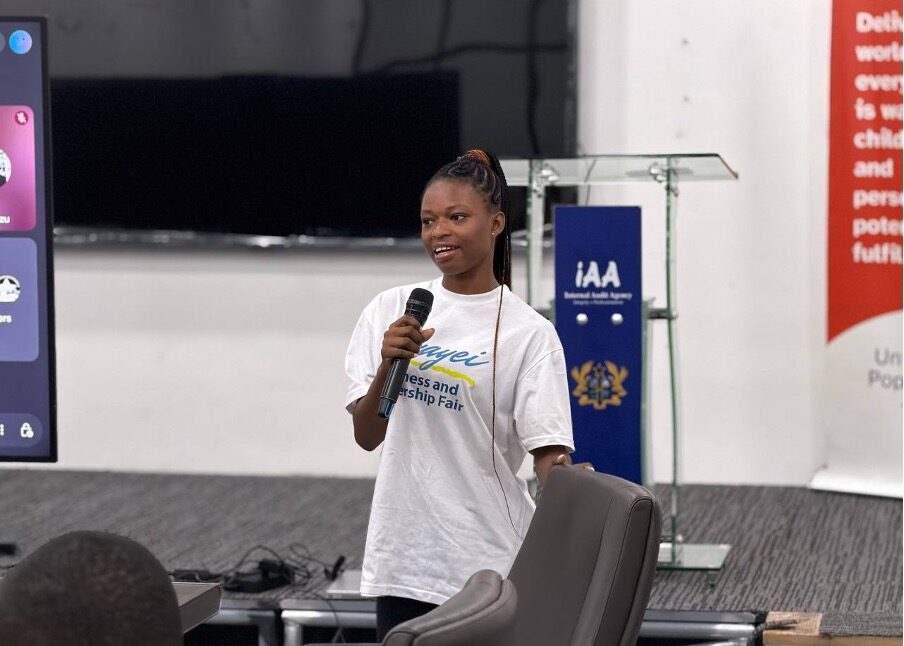
Once without a stable home and uncertain about her future, Bazaara Serinye Priscilla is now preparing to begin a Bachelor of Laws degree, with her sights set on becoming a lawyer.
Her journey from hardship to ambition was shaped by support from the Purim African Youth Development Platform (PAYDP), the United Nations Population Fund (UNFPA) and the Chief Justice Mentorship Programme.
Priscilla shared her story at a one-day capacity-building workshop on UNFPA Country Programme Reporting and Development Communication in Accra on November 5, 2026. The workshop, organised by the Media and Communication Advocacy Network (MCAN) in collaboration with UNFPA and Global Affiars Canada, aimed to strengthen media coverage of development programmes and document the real-life impact of interventions on adolescent girls.
A difficult beginning
Priscilla’s challenges began after she dropped out of school and moved in with her sister, who was then an apprentice. To survive, she worked as a salesgirl in the market.
Her situation became more difficult when she became pregnant but lost her baby days before her expected delivery. She returned to her mother’s home, where her mother encouraged her to register with an organisation supporting out-of-school girls.
Although she was initially reluctant to join, Priscilla eventually took part in the programme. There, she met a former teacher who recognised her academic potential and encouraged her to return to school.
Searching for stability
Hoping to earn money and pursue her ambitions, Priscilla later travelled to Accra in search of work. But life in the city proved difficult, and at one point she slept at a market before a woman offered her temporary accommodation.
She later left that accommodation after discovering that the woman wanted to involve her in activities, she was not comfortable with.
A friend eventually invited her to an adolescent sexual and reproductive health programme, where she reconnected with a PAYDP representative she had met during earlier workshops. That encounter opened the door to further opportunities.
A turning point
When the PAYDP representative asked about her aspirations, Priscilla said she was interested in cosmetology. But her participation in the programme later connected her to the Chief Justice Mentorship Programme, which exposed her to the legal profession and strengthened her confidence.
“I met PAYDP at first, and they were working with UNFPA, and through them we went for some Chief Justice mentoring programmes, and I was empowered. So, I chose to do law,” she said.
Priscilla is now preparing to begin her LLB programme at the Ghana Institute of Management and Public Administration (GIMPA) in February 2027.
Mentorship and mindset
Reverend Aku Xornam Adzraku-Kevi, Executive Director of PAYDP, said the mentorship programme, led by Ghana’s Chief Justices, allows judges to engage adolescent girls on the justice system while encouraging them to develop positive mindsets and take charge of their futures.
She argued that practical skills and financial support alone are not enough to transform the lives of vulnerable girls. According to her, mindset transformation and leadership development are equally important.
“One of the things you realise is that you can do whatever programme you want to do, but if you do not do mindset shifting and leadership empowerment for these girls, you are just wasting your money,” she said.
Reaching vulnerable girls
PAYDP, with support from UNFPA and other partners, has reached more than 100,000 women and girls through interventions focused on sexual and reproductive health education, protection from sexual and gender-based violence, livelihood empowerment and leadership development.
The organisation works with adolescent girls, head porters known as kayayei, teenage mothers, parents and traditional leaders. Its programmes include community engagements, durbars and outreach activities implemented with the Ghana Health Service and other non-governmental organisations.
Reverend Adzraku-Kevi said the interventions also address harmful practices and abuse affecting vulnerable girls, including female genital mutilation, rape and sexual abuse, often in collaboration with the Domestic Violence and Victim Support Unit (DOVVSU) and Social Welfare.
Skills for independence
Beyond reproductive health education, PAYDP has introduced livelihood initiatives in cassava and potato flour processing, basket weaving, animal rearing, farming and cosmetics production. Some of the cosmetics produced through the programme have been registered with the Food and Drugs Authority.
The organisation has also established cooperatives to help girls build sustainable livelihoods. Reverend Adzraku-Kevi said equipping girls with income-generating skills is essential to ensuring that reproductive health education translates into real independence.
“One of the things we realised is that if you only give the girls reproductive health information and you do not give them livelihood empowerment, the girls are a bit defective and they will not be able to support themselves,” she said.
A message to other girls
Priscilla urged girls, especially those living on the streets, to speak openly about their ambitions and seek support. She said expressing their needs can help organisations and individuals identify opportunities to assist them.
“Sometimes we go out to preach to some of the ladies on the street, especially the girls. So I would like everyone to be bold in communicating with us about what they want to do, how we can help, and then we take it from there. My biggest dream is to become a lawyer,” she said.